
Rejuvenate Thinning Hair With Microneedling & Copper Peptides

Thinning hair can change how you feel about your reflection long before it becomes obvious to anyone else. A wider part, a receding hairline and increased shedding can all be signs that your follicles need more support. Fortunately, addressing hair loss early offers the best opportunity to preserve your existing hair and support healthier growth over time.

At Hakimi Plastic Surgery, we know that stronger hair starts with healthier follicles. We offer scalp microneedling with copper peptides for patients throughout Beverly Hills and Los Angeles, a nonsurgical treatment designed for men and women with thinning hair who want targeted support without incisions, grafts or downtime.

Hair Restoration Overview

01 // What It Is

Scalp microneedling with copper peptides to stimulate hair follicle activity and support new growth in thinning areas.

02 // How We Do It

Dr. Hakimi develops personalized protocols for men and women, using a two-step process to enhance peptide absorption.

03 // Why You Want It

Your hair has been thinning, but you want an option that addresses follicle health without surgery or downtime.

04 // Recovery Time

No downtime, few side effects and almost no visible signs of treatment; return to work the next day.

What Is Nonsurgical Hair Restoration With Peptides?

Nonsurgical hair restoration is a minimally invasive treatment that combines scalp microneedling with copper peptide therapy to address thinning hair. Microneedling creates controlled micro-channels in the scalp while stimulating a natural healing response, and copper peptides are applied when the follicles are most receptive, supporting healthier hair over time.

Today, the two most relevant peptides for hair restoration are GHK-Cu (copper tripeptide-1) and AHK-Cu (copper tripeptide-3), which support hair growth by:

  • Reducing inflammation to create a stronger, healthier scalp environment
  • Activating pathways that regulate the hair growth cycle
  • Encouraging the formation of new blood vessels that nourish the hair follicles
  • Supporting cellular activity linked to hair follicle regeneration

This approach is not a shortcut. Hair growth is gradual by nature, so noticeable change takes time to appear. With copper peptides or any other nonsurgical hair restoration treatment, three to six months of consistent use is recommended before evaluating your results and progress.

Book Now

What Can Nonsurgical Hair Restoration Help With?

Scalp microneedling with copper peptides is best suited for patients who are starting to notice early or moderate thinning. When you can see and feel a change in your hair but aren’t ready for surgical or prescription-based treatments, this approach may be a good fit.

It can address concerns such as:

  • A widening part
  • Visible thinning at the crown
  • Changes in fullness or density
  • Increased shedding
  • Finer, weaker hair strands
  • A receding hairline

Nonsurgical hair restoration is not designed to replace a hair transplant or restore growth in areas where the follicles are no longer active. During your consultation at Hakimi Plastic Surgery, we consider factors like the extent of your hair loss and treatment goals to determine whether microneedling with copper peptides is right for you.

Hair Restoration for Women

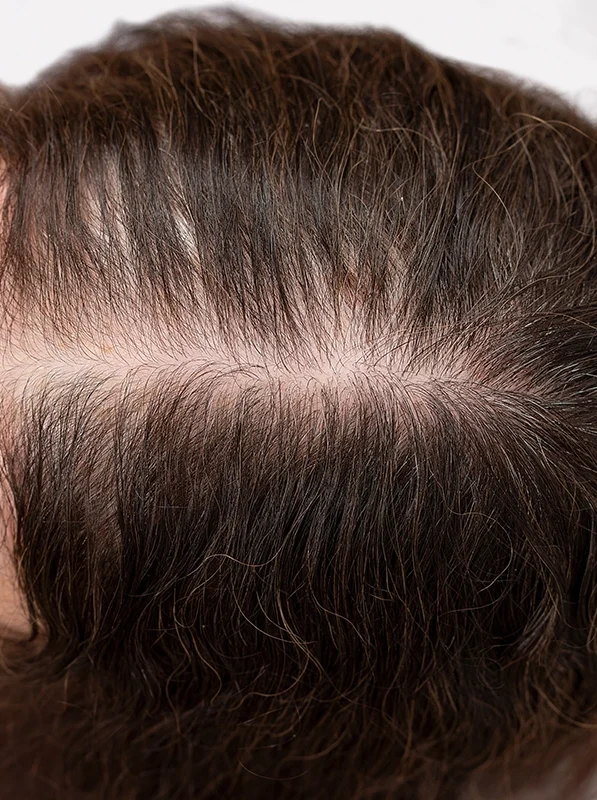
Hair loss in women rarely looks like it does in men. Instead of a receding hairline, it usually shows up as a widening part and gradual thinning across the top of the scalp, a pattern hair restoration specialists grade on the Ludwig scale. Many women first notice it when a ponytail feels thinner or more strands appear on pillows, shower floors and hair brushes.

Scalp microneedling with peptides gives women a non-hormonal way to support thinning hair. It can help with female pattern hair loss, mild alopecia areata and the increased shedding that often follows pregnancy, a temporary condition called telogen effluvium. With the right plan and consistent treatment, many women see visible improvement in thinning areas, with hair that looks fuller and feels more like their own again.

When Will I See Results?

Nonsurgical hair restoration is a gradual process. Most patients begin to notice subtle improvements after two to three sessions: less hair in the shower drain, improved texture or shine, strands that feel less fragile, and better coverage in thinning areas. With consistent treatments, more visible changes in hair density appear around the three to four-month mark.

Results are cumulative, continuing to build over time as the treatment series progresses. Copper peptides are not an overnight fix, but for patients who are noticing early thinning, they offer a proactive way to support the hair they still have, improve scalp health and start doing something meaningful without jumping straight to injections or surgery.

How Does Nonsurgical Hair Restoration Work?

01 // Before Your Procedure

Your first step is a consultation with Dr. Hakimi. He will assess the degree and pattern of thinning, evaluate your scalp health and discuss any relevant hormonal or genetic factors that may be contributing. If nonsurgical restoration is a good fit, he will outline a personalized treatment schedule with realistic expectations.

02 // During Your Procedure

On the day of your procedure, the scalp is cleansed and a topical numbing agent is applied to keep the treatment comfortable. Dr. Hakimi then uses a microneedling device to create micro-channels across the thinning areas, adjusting needle depth based on your needs and comfort level. Immediately after, a copper peptide serum is applied directly to the scalp, where it can penetrate deeply to nourish the hair follicles.

03 // After Your Procedure

Expect mild redness, warmth and scalp sensitivity for 24 to 48 hours following your session. Some pinpoint bleeding is also common, but this resolves quickly. Scalp microneedling with peptides leaves little to no visible signs of treatment, so most patients are comfortable returning to work the next day. There are just a few activity restrictions to consider, mostly around sun exposure and hair washing, but Dr. Hakimi will review these with you before you leave for optimal healing and results.

How Does This Compare to PRP for Hair Loss?

Platelet-rich plasma (PRP) therapy has been a widely offered option for hair loss for over a decade. It involves concentrating growth factors from your own blood and applying them to the scalp via injection or microneedling. It’s effective for many patients, but results can vary depending on platelet concentration and technique.

Neither approach is universally superior. Depending on your goals, one may be recommended first, or both may be used as part of a comprehensive plan.

Copper Peptides vs. PRP

Copper Peptides PRP
Mechanism GHK-Cu and AHK-Cu copper peptides Autologous growth factors derived from blood
Delivery Microneedling Injection or microneedling
Injections required? No Yes
Blood draw required? No Yes
Session time 45 to 60 minutes 60 to 90 minutes
Downtime Minimal Minimal

FAQ

How many sessions are needed?

Most patients start with a series of four to six sessions, followed by a maintenance phase. Maintenance sessions are typically scheduled every two to three months after the initial series, depending on your response and goals.

Is nonsurgical hair restoration with peptides suitable for women?

Yes, microneedling with copper peptides is safe and effective for both men and women bothered by thinning hair. It provides a non-hormonal way to stimulate new growth for women experiencing female pattern hair loss, postpartum shedding and mild cases of alopecia areata.

Why are copper peptides combined with microneedling?

Copper peptides have shown promising results in promoting hair growth, but do not easily penetrate the skin when applied topically. Microneedling changes that by creating micro-channels in the scalp, dramatically increasing absorption. Many patients also pair microneedling with other topicals, including minoxidil, for this same reason.

How is this different than a hair transplant?

Microneeding with copper peptides offers a less invasive way to support thinning hair before moving on to more aggressive treatments. Instead of surgically harvesting healthy follicles from a donor site to balding areas, copper peptides help create a healthier scalp environment for follicles that are still active. For patients comparing their options, the question often comes down to where they are in the hair loss process and how much intervention they feel ready for.

Is this a good alternative to PRP for hair loss?

Yes, especially for patients who are interested in PRP but hesitant about the process. Copper peptide hair restoration does not require a blood draw or scalp injections, which makes the experience simpler from start to finish. It may be recommended for early thinning, maintenance or for patients who want a less invasive treatment before considering PRP.

What risks or side effects are associated with this treatment?

Scalp microneedling with copper peptides carries a low risk of side effects when performed by a qualified, experienced provider. Temporary side effects may include redness, mild sensitivity and minor scalp irritation that resolve within 24 to 48 hours. Serious complications are rare.

Can Hair Restoration Be Combined With Other Treatments?

Yes, scalp microneedling with copper peptides can, and often should be, part of a broader hair restoration plan. Hair loss rarely has a single cause, so the most effective approach involves addressing the issue from several angles. While FDA-approved medications like minoxidil and finasteride remain the most proven options, copper peptides excel as a complementary therapy, and for many people, may be the “missing link” that takes their results to the next level.

What Sets This Program Apart?

01 // Board-certified plastic surgeon oversight

Every treatment plan is developed and supervised by Dr. Hakimi himself, tailored to your specific type of hair loss.

02 // Medical-grade formulations

The copper peptide serums used in this program are medical-grade, not the lower concentrations found in retail settings.

03 // Personalized session planning

Needle depth, peptide concentration and session frequency are adjusted based on your response to treatment.

04 // Natural-looking results

Growth is stimulated at a cellular level for results that develop gradually, blend in seamlessly and look completely natural.

Restore Your Hair Without Surgery in Beverly Hills

Hair restoration is not one-size-fits-all. At Hakimi Plastic Surgery, our focus is on helping you understand your options and building a plan that makes sense for your situation. If you’ve noticed increased shedding or a widening part and want an honest assessment of what nonsurgical restoration can do for you, schedule a consultation with Dr. Hakimi and his team today. Call our Beverly Hills office at 424-239-5201 or book online to get started.

Book Now
#GlowUp

Chat Live With The Office