Breast augmentation can improve your body proportions and help you feel more like yourself again. But whether you recently got implants or you’re still researching the procedure, the recovery process can feel like uncharted territory. How much swelling is too much? Why do your breasts sit so high on your chest? And when should you call your surgeon?
Dr. Michael Hakimi, a board-certified plastic surgeon in Beverly Hills, hears these questions from patients every day. Understanding the typical healing process can help you feel more confident as your body adjusts to your new implants. Here’s what to expect at every stage of recovery, warning signs that warrant a phone call and how newer techniques like awake breast augmentation can affect your overall experience.
The First 48 Hours: Immediate Post-Surgery Recovery
The initial hours after breast augmentation are often the most intense. Your body has just been through surgery and needs rest. During these first two days, expect the following:
- Swelling and tightness. Your breasts will feel firm, swollen and possibly sore. Many patients describe a sensation of pressure or tightness across the chest.
- High positioning. Don’t be alarmed if your implants ride high on the chest or look somewhat flat. They’ll “drop and fluff” in the weeks after your procedure, settling into a more natural position and filling out the lower pole of the breast better.
- Mild to moderate pain. Discomfort can be managed with prescribed medications. Patients who undergo submuscular placement (beneath the chest muscle) may experience more soreness than those with subglandular placement (above the muscle).
The First Week of Healing
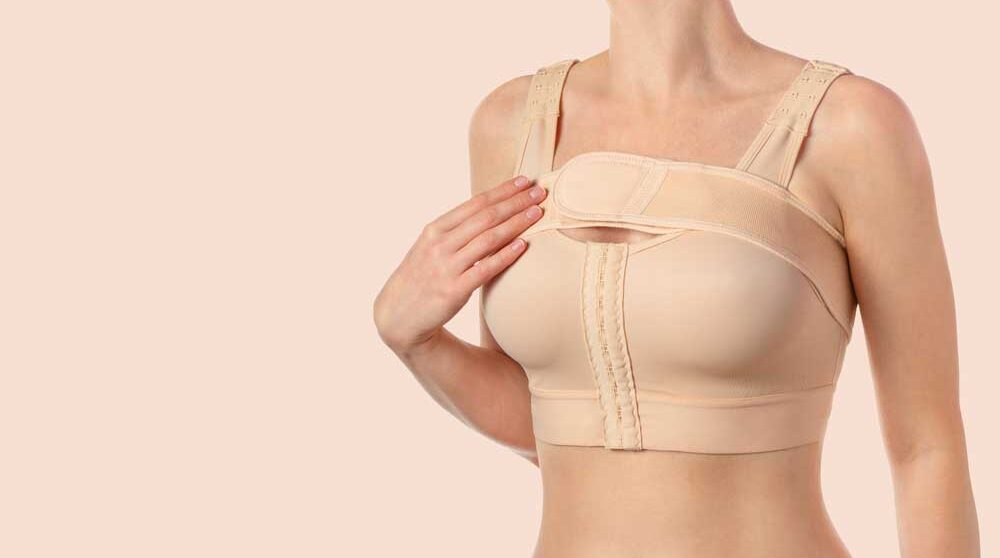
Bruising and swelling typically peak after three to five days before gradually fading. During this phase, prioritize rest. Light walking is encouraged to promote circulation and reduce the risk of blood clots, but don’t overdo it. Avoid strenuous exercise and do not lift anything heavier than 10 pounds until cleared by your surgeon. You’ll likely wear a surgical support bra 24/7 for several weeks to minimize swelling and support your new contours.
With a traditional breast augmentation, most patients report feeling significantly better by day five to seven and return to desk work by this time. The initial tightness begins to ease, and pain levels decrease noticeably.
For those who opt for awake breast augmentation or Preservé by Motiva (more on these techniques later), the return-to-normal timeline is even shorter.
Developing Results & a Gradual Return to Normal
You’ll be able to appreciate the increased volume and fullness of your breasts right away, but your final results are still developing. Three to four weeks out from surgery, your breasts will start to “drop and fluff.” While the term sounds informal, it accurately describes what happens as the implants settle: they descend into a lower, more anatomically correct position (drop) and fill out the lower part of the breast as the skin and tissue relax (fluff).
As far as recovery goes, you’ll be back in the swing of your normal routine by this point, but continue to avoid chest exercises and heavy lifting until cleared by Dr. Hakimi. Most patients can resume strenuous exercise like running, weightlifting and high-impact cardio around the six-week mark. If you feel any pain or discomfort during these activities, listen to your body and slow down. Trying to do too much too soon can compromise healing.
How Implant Placement Affects Recovery
Where your surgeon places your implants significantly impacts your recovery experience.
Submuscular placement positions the implant beneath the pectoralis (chest) muscle. This technique typically creates more natural-looking results, reduces visible rippling in patients with less natural breast tissue, and lowers the risk of capsular contracture. However, because the muscle must be carefully detached from the chest wall, the recovery tends to involve more discomfort. The pectoral muscle also needs time to adjust to the implant underneath it.
Subglandular placement positions the implant above the muscle, eliminating the need to detach it from the chest wall for a faster, less painful recovery. This option works well for patients with adequate breast tissue to hide implant rippling, but athletic women also prefer subglandular placement to avoid the “animation deformity” that can occur when the chest muscles flex. Motiva implants have made subglandular placement possible for more women thanks to advanced ProgressiveGel™ and SmoothSilk™ technologies. Motiva implants also have a low rate (0.5%) of capsular contracture regardless of where the implant is placed.
Awake Breast Augmentation: A Different Recovery Experience
Awake breast augmentation is gaining popularity, and Dr. Hakimi offers this advanced option at his Beverly Hills practice. He has even been featured in an article by the American Society of Plastic Surgeons (ASPS) discussing awake plastic surgery, noting that patients are “sedated and comfortable, but they’re awake enough that if I call their name to move around, they can help me and they can converse.”
This approach to breast augmentation offers several benefits, including:
- Faster recovery from anesthesia. Without general anesthesia, you avoid the grogginess, nausea and lingering “hangover” effect that can last several days after surgery. Many patients feel clear-headed within hours of their procedure.
- Reduced risk profile. Eliminating general anesthesia removes the associated cardiovascular and respiratory risks, making the procedure safer for patients with a higher BMI or certain health conditions.
- Real-time feedback. You can communicate with your surgeon during the procedure. Some surgeons find this helpful for achieving optimal symmetry and placement.
- Lower overall cost. Awake procedures typically cost less because they don’t require an anesthesiologist or the specialized equipment necessary for general anesthesia.
At Hakimi Plastic Surgery, awake breast augmentation is done with Motiva implants placed above the muscle. This pairing makes sense: Motiva’s advanced technology allows for over-the-muscle placement without the visible rippling that has historically been a concern with subglandular positioning, and because the procedure doesn’t involve cutting or manipulating the chest muscle, it’s inherently less invasive than traditional submuscular augmentation.
Since the chest muscle remains untouched, post-op discomfort tends to be milder. Patients often report less tightness, less soreness and an overall easier first week, with most feeling comfortable resuming light routines within just a few days.
Learn More About Awake Breast Augmentation
The Awake Procedure Experience
Motiva Implants and the Preservé™ Technique
Dr. Hakimi offers another advanced approach using Motiva implants: the Preservé technique, which uses specialized tools for a minimally invasive breast augmentation that can be performed with local anesthesia. This system uses a channel separator and inflatable “balloon” to gently push the nerves and blood vessels aside, making room for the implant without cutting or excessive stretching. This preserves your natural tissue, resulting in a more comfortable recovery with significantly less pain.
Dr. Hakimi is a Sulàyöm-certified surgeon, which means he has undergone advanced training at Sulàyöm Innovation Campus, a global learning center for healthcare professionals. The Sulàyöm Innovation Campus is owned by Establishment Labs, the makers of Motiva implants. There, he mastered next-generation, minimally invasive techniques, including the Preservé breast augmentation approach offered by just a handful of surgeons in Beverly Hills.
What Complications Should I Watch For After Breast Augmentation?
The risk of complications is low when breast augmentation is performed by a skilled, board-certified plastic surgeon like Dr. Hakimi, but there are still some symptoms you should look for to ensure optimal healing and results.
Capsular Contracture
When your body forms a capsule of scar tissue around an implant, it’s a normal part of the healing response. Capsular contracture occurs when this capsule tightens and hardens, squeezing the implant and potentially causing pain, firmness or distortion. Research suggests this complication affects roughly 5% to 19% of breast augmentation patients, although these rates are significantly lower with Motiva implants.
Warning signs include:
- Unusual firmness or tightness in the breasts
- Distorted breast shape
- Pain or discomfort not associated with recent activity
- Restricted implant movement (the implant feels “stuck” in one position)
Hematoma
A hematoma occurs when blood collects outside blood vessels in the surgical area. It typically presents as sudden, pronounced swelling on one side, often accompanied by pain, bruising and firmness. Small hematomas may resolve on their own, but larger collections often require surgical drainage to prevent infection and reduce the risk of capsular contracture.
Warning signs include:
- Sudden pain in the breast
- Excessive swelling that makes one breast look larger than the other
- Blood drainage from incisions
- Extensive bruising or discoloration
- One breast feels unusually firm or hard
Seroma
Seroma refers to fluid accumulation around the implant. Unlike the intense pain of a hematoma, a seroma typically causes wave-like swelling without significant bruising or discomfort. Small seromas often resolve independently, while larger ones may need needle aspiration.
Warning signs include:
- Soft lump under the skin near the surgical site
- Discomfort or tightness in the breast
- Clear or yellowish discharge from incisions
- Redness or soreness in the affected area
When to Call Your Surgeon
Some complications, like the signs of infection, warrant immediate attention. Call your surgeon if you experience any of the following symptoms:
- Increasing pain after day three (pain should be decreasing, not getting worse)
- Unusual warmth or redness around incision sites
- Fever above 100.4°F
- Any foul-smelling drainage from the incisions
For peace of mind, you can also contact your surgeon if you have any symptoms that concern you, including unusual changes in breast shape, firmness or position. Dr. Hakimi maintains direct communication with his patients after surgery, so you can call or text anytime.
Ready to Explore Your Options?
If you’re considering breast augmentation and want to explore your options, from traditional breast augmentation to awake techniques with Motiva implants, schedule a consultation with board-certified plastic surgeon Dr. Hakimi. His Beverly Hills practice offers one-on-one attention with a focus on honesty and personalized care. Get started by calling Hakimi Plastic Surgery at 424-239-5201 or request a consultation online.